
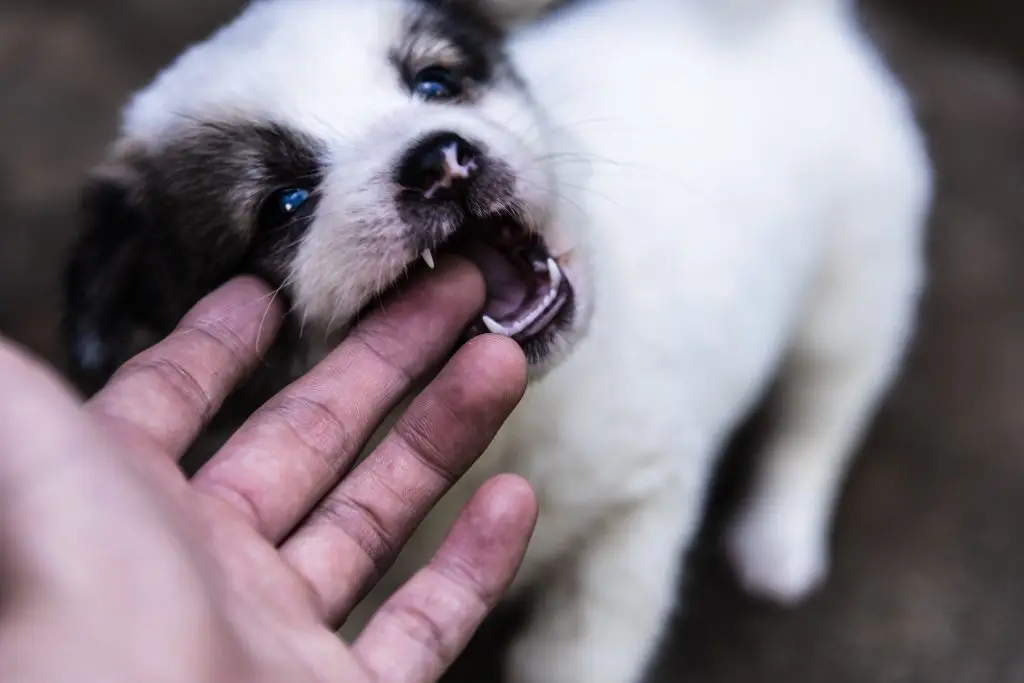
If your new puppy is treating your hands and ankles like chew toys, take a deep breath—you are not alone. While those sharp “puppy teeth” can be painful, mouthing is a completely normal developmental stage. At Golden Paw Pet Services, we focus on positive reinforcement to teach your puppy how to interact with the world gently, ensuring they grow into well-mannered companions without the need for fear or punishment.
Quick Answer: How Do You Stop Puppy Biting?
The fastest way to stop biting is to redirect their energy to an appropriate toy every time they start to mouth. If they continue, remove your attention immediately by standing up and turning away. By “removing the fun” (your attention), you teach them that biting ends the interaction, while using toys teaches them what they can bite instead.
Why Puppies Bite and Mouth
Puppies don’t have hands, so they explore their environment with their mouths. Understanding the cause is the first step toward correcting it:
- Teething: Just like human babies, teething causes discomfort. Chewing relieves the pressure in their gums.
- Play Behavior: In the litter, puppies wrestle and nip. They are simply trying to engage you in the same way they interacted with their siblings.
- Overexcitement: When puppies get the “zoomies” or become overstimulated, they often lose control of their mouth.
- Bite Inhibition: They haven’t learned yet that human skin is far more sensitive than their littermates’ fur.
- Attention-Seeking: If you react by pulling away, yelping, or pushing them, they may think you are playing a game of “tag,” which only encourages more biting.
What Is Bite Inhibition?
Bite inhibition is the puppy’s ability to control the force of their jaws. In a healthy litter, when one puppy bites another too hard, the “victim” yelps and stops playing. This teaches the biter, “Oh, if I bite hard, the fun stops.” Your goal is to replicate this lesson, teaching them that human skin is delicate and that gentle play is the only way to keep the game going.
How to Stop Puppy Biting: Step by Step
- Redirect to Toys: Always keep a toy handy. When your puppy approaches with “hungry” eyes, offer them a rope or stuffed toy immediately. Reward them for biting the toy instead of you.
- The “Stop-and-Go” Method: If teeth touch your skin, say a firm (but not loud) “No” or “Enough,” and stop moving. If they persist, calmly stand up and cross your arms, ignoring them for 10–15 seconds.
- Reward Calm Behavior: When your puppy is playing nicely and using their toys, shower them with praise and treats. You want them to realize that calmness earns the best rewards.
- Cooling Toys: If your puppy is actively teething, provide frozen washcloths or rubber teething toys. The cold provides soothing relief for inflamed gums.
- Avoid Rough Hand Play: Never use your bare hands to wrestle or “roughhouse” with your puppy. This teaches them that hands are toys.
What Not to Do
- Do Not Yell or Use Physical Punishment: Yelling or “muzzle-grabbing” can cause your puppy to become fearful or, worse, develop defensive aggression.
- Do Not Pull Away Quickly: A quick, jerky movement mimics prey, which triggers a puppy’s natural instinct to chase and bite harder.
- Do Not Tease: Avoid poking or prodding your puppy to get a reaction; this leads to overstimulation.
When to Be Concerned
Most puppy biting is purely exploratory. However, if your puppy is lunging with stiff body language, growling intensely, or biting out of fear/resource guarding rather than playful exploration, it is time to consult a professional trainer.
How Golden Paw Pet Services Can Help
At Golden Paw Pet Services, we know that puppyhood is overwhelming.
- Structured Socialization: Our playgroups allow puppies to learn bite inhibition from other dogs, which is often faster and more effective than anything a human can teach.
- Professional Training: Our trainers provide personalized plans to redirect energy and build confidence, helping your puppy master “gentle mouth” habits in a supportive, positive environment.
FAQ
At what age do puppies stop biting?
Most puppies significantly reduce their mouthing by 5–6 months old, once their adult teeth have fully emerged.
How do you teach a puppy not to bite hands?
By making your hands “boring” when they bite, and “interesting” when they interact with a toy. If the mouth hits the hand, the game ends immediately.
Is puppy biting aggressive?
Usually, no. It is almost always playful or explorative. True aggression involves different body language, such as extreme stiffening, deep growling, or snapping with intent to harm.
Should you yell when a puppy bites?
No. Yelling often excites a puppy further or creates fear. Use a calm, neutral tone of voice or simply go silent to communicate that the fun is over.
What toys help with puppy biting?
Look for toys with different textures—rubber chew toys for gum pressure, rope toys for tug-of-war, and soft plush toys for comfort.
Need extra help raising a calm, well-behaved puppy? Our team at Golden Paw Pet Services is here to support you! Click here to contact us today to learn about our puppy training and socialization programs!