
Walking your dog should be the best part of your day, not a workout for your arms. While “walking on a leash” just means not pulling, the “Heel” command is a specific position: your dog walks closely beside your leg (usually the left), maintaining your pace and stopping when you stop. In the U.S., professional trainers prioritize “heeling” as a way to navigate busy streets, vet offices, and crowded parks safely.
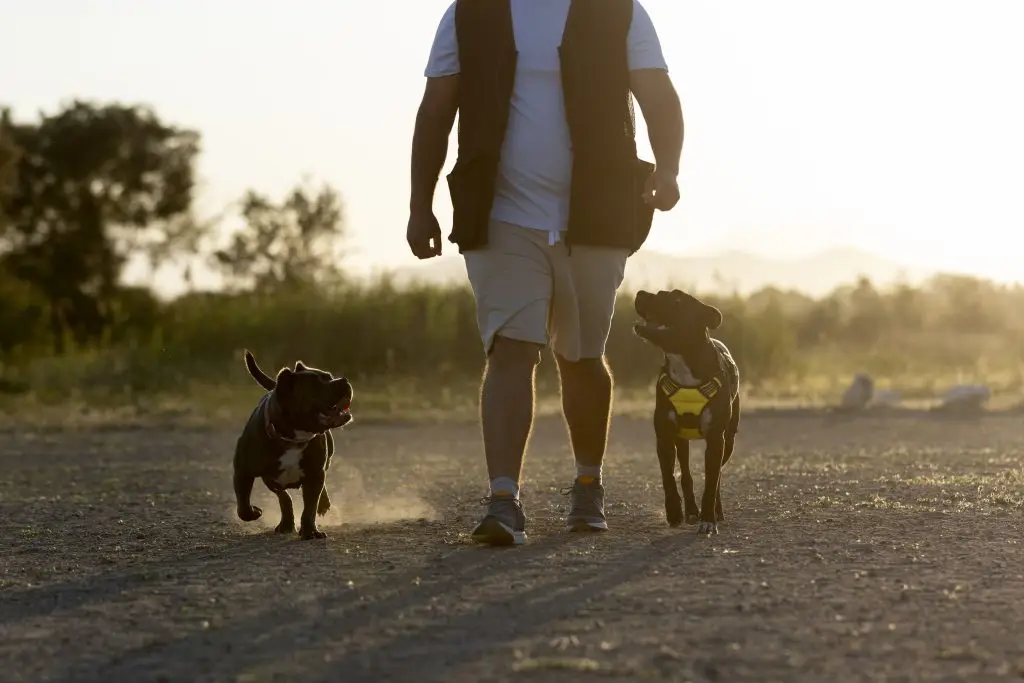
Quick Answer: Focus and Positioning
The secret to a perfect heel is engagement. If your dog is looking at you, they aren’t looking for squirrels. Use high-value treats held at your hip level to “lure” your dog into the correct position. The goal is to reward the dog for staying in the “sweet spot”—the zone where their shoulder is aligned with your knee—rather than pulling ahead.
Step-by-Step Heel Training: Mastering the Position
Before you head outside, practice in a quiet hallway where there are no distractions.
Step 1 – Find the “Sweet Spot”
Start with your dog standing on your left side. Hold a handful of small treats in your left hand. Show the dog the treat to get their nose near your knee. This is the “Heel” position.
Step 2 – The First Steps
Say your dog’s name followed by “Heel!” and take two steps forward. If your dog stays beside you, say “Yes!” and give them a treat immediately. If they bolt ahead, stop and reset.
Step 3 – Increase Duration
Once they can do two steps, move to five, then ten. Keep the treats coming frequently at first. You want the dog to think, “Staying next to this leg is a treat-dispensing machine!”
Step 4 – Introduce “The Automatic Sit”
When you stop walking, your dog should sit by your side. As you slow down to a stop, lift the treat lure slightly up and back over their head. When they sit, reward them heavily. Soon, they will learn to sit automatically every time you stop at a crosswalk.
Common Leash Problems
Even the best-trained dogs face challenges. In American neighborhoods, these are the most common hurdles:
- Pulling Toward Scents: Dogs experience the world through their noses. If they lung toward a smell, stop moving. Do not pull back; simply become an “anchor.” Only move forward again when the leash goes slack.
- Reacting to Other Dogs: If your dog loses focus when they see another pet, increase the distance. Use high-value “jackpot” treats to keep their eyes on you until the other dog passes.
- Forging Ahead: If your dog constantly walks 2 feet in front of you, practice frequent “about-turns.” Turn 180 degrees and walk the other way; your dog will have to hurry to catch up to your side.
Training Mistakes to Avoid
- Using a Tight Leash: If you keep the leash tight, the dog will instinctively pull against the pressure (the “opposition reflex”). Keep the leash in a “J” shape—loose and relaxed.
- Using a Retractable Leash: These are generally discouraged for training “heel.” They teach the dog that pulling actually extends their range, which is the opposite of what you want.
- Correcting with Anger: Jerking the leash or yelling creates anxiety. Behavioral science shows that rewarding the correct position is much faster than punishing the wrong one.
- Inconsistency: If you let them pull on the way to the park but expect a “heel” on the way home, the dog will be confused. Pick a cue for “free walking” and a cue for “heel.”
FAQ: Heeling and Leash Manners
Why does my dog walk fine inside but pull outside?
This is a lack of generalization. Outside, the world is full of “competing motivators” (squirrels, cars, smells). You need to use much higher-value treats (real meat or cheese) when transitioning to outdoor training.
Which side should my dog heel on?
Traditionally, dogs heel on the left side. This dates back to hunting and military traditions, but for a family pet, the side doesn’t matter—consistency does. Pick a side and stick to it.
My dog is a “power puller.” Should I use a harness?
A front-clip harness is an excellent tool for training. Because the leash attaches to the chest, if the dog pulls, it gently pivots their body back toward you, breaking their forward momentum without causing pain.
Need Help With Pet Care or Training Reinforcement?
At Golden Paw Pet Services, we know that a walk is more than just a potty break—it’s an opportunity for mental stimulation and behavior reinforcement. Our professional walkers are trained to maintain the “loose-leash” standards you’ve set, ensuring that every walk is a step toward a better-behaved companion.
- Structured Walk Protocols: We practice “heel” and “auto-sits” at every curb.
- Equipment Expertise: We are experienced with front-clip harnesses, head halters, and standard leads.
- Consistent Reinforcement: We use your specific cues to keep your dog’s training sharp while you’re away.